Why we still sketch on paper
Paper is slower, messier and impossible to share. That is exactly why it keeps earning its place at the start of every project we take on.

Mara Ellison
Writer and design lead
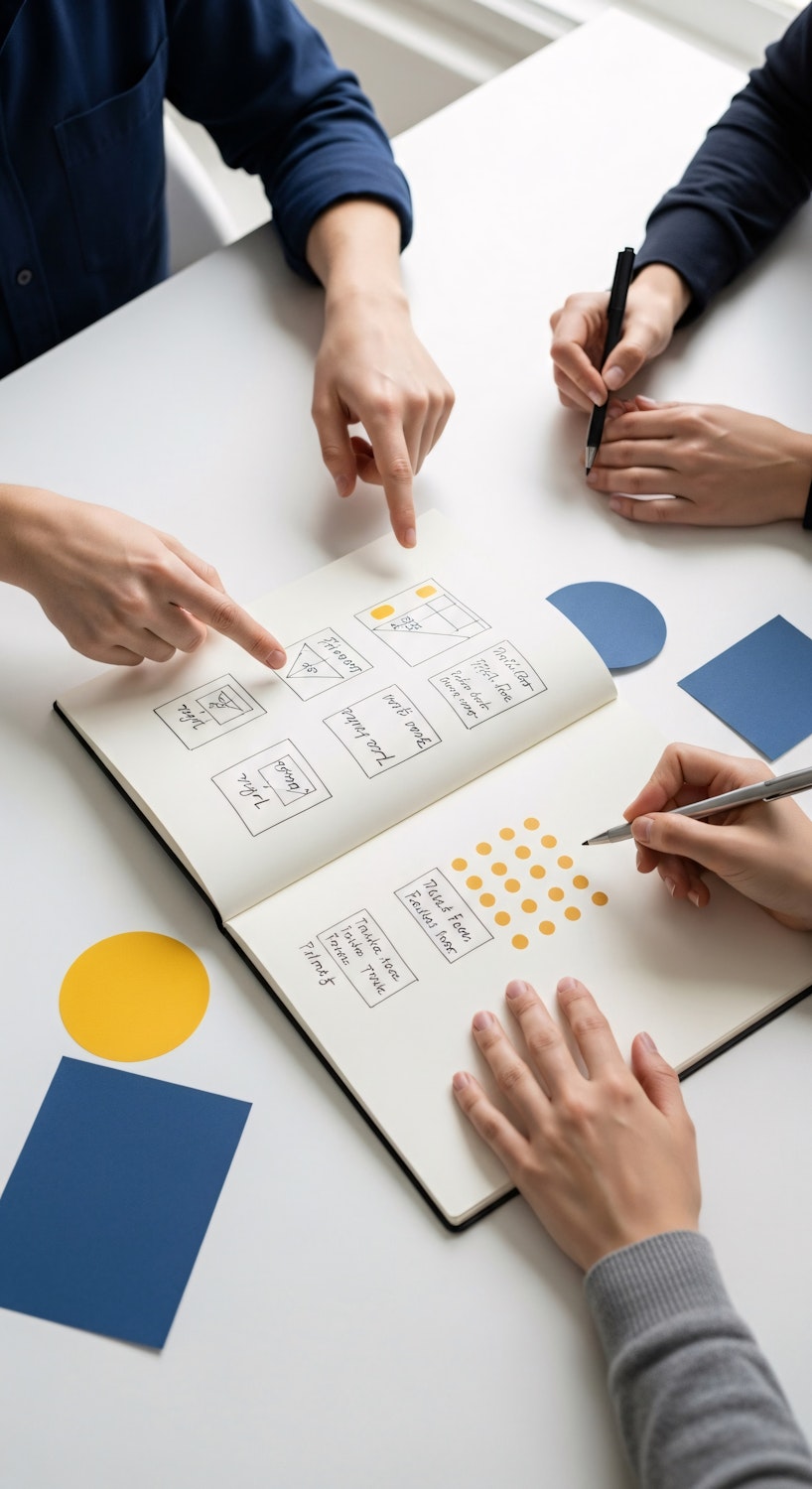
Our studio has good tools. We could open any of them and start moving rectangles around within about four seconds. Instead, most weeks begin with a table, a stack of cheap paper and a box of pencils that nobody keeps track of.
It is not nostalgia. Paper does three things that a screen quietly refuses to do.
It refuses to look finished
A sketch is obviously provisional. Nobody argues with the corner radius of a pencil line, and nobody assumes a decision has been made just because something appeared on a page. That looseness buys a room full of people permission to disagree early, while disagreeing is still cheap.
On a screen the opposite happens. Type is set, spacing is even, colours are chosen, and suddenly a rough idea is wearing a suit. People respond to the suit. They start editing details of a thing whose shape is still wrong.
It keeps the whole problem visible
Twelve sketches can sit side by side on one table. Twelve screens cannot. There is no scrolling, no switching, no window on top of another window. Everyone in the room can see the full range of what has been considered, which is the only reliable way to notice the option nobody has drawn yet.
It is fast enough to be honest
The gap between having a thought and seeing it is roughly one second on paper. That speed matters more than fidelity, because it means a bad idea can be tested and abandoned before anybody has invested enough effort to defend it.
- Draw six options, not one.
- Give each one ninety seconds.
- Say what is wrong with your own before anyone else does.
- Photograph the table, then throw the paper away.
Where it stops
Paper is a terrible place to end. It does not scroll, resize, load slowly, or fail on a narrow screen, and every one of those things is where real design decisions live. So the sketch is a starting gun and nothing more. We usually spend one morning on paper and the rest of the project in the browser, which sounds like a small ratio until you count how many arguments that morning prevents.
Written by
Mara Ellison
Writer and design lead
Mara has spent twelve years shaping products for small teams, mostly by asking slower questions than anyone wanted. She writes Fieldnotes on Sunday mornings, usually before the house wakes up.